It’s stunning how, after three many years in woodworking, I may nonetheless be caught utterly off guard by a easy, basic reality concerning the materials I exploit day by day. For thirty years, I primarily relied on kiln-dried lumber for my initiatives—both reclaimed wooden that was already steady or new inventory at that excellent 5% to eight% moisture content material. I operated below the belief that I knew wooden.
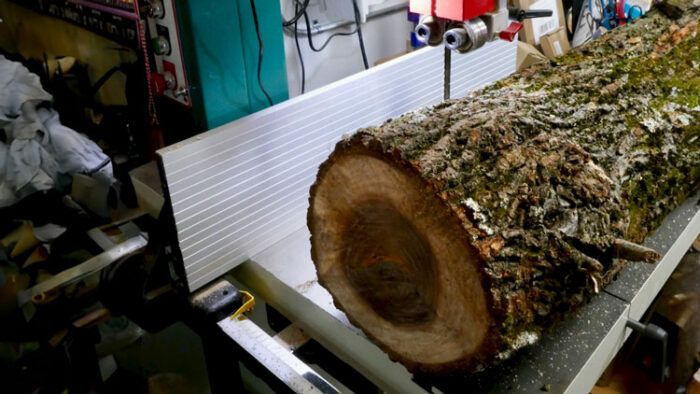
However when nature offered a possibility—a freshly trimmed walnut limb—I couldn’t resist. I made a decision to show that stunning department into slabs. I actually thought it might be easy. Actually, I speculated that the ample moisture within the wooden would possibly even lubricate and easy out the resawing course of.
I used to be profoundly mistaken. The expertise was messy, but it surely proved to be a useful lesson. Whereas my story would possibly warning some away from resawing inexperienced wooden, for individuals who, like me, can’t bear to see an exquisite limb go to mulch, I can now provide a roadmap—and set clear expectations.
The Origin Story: From Automata to Air-Drying
This journey started on the conclusion of a category I taught at Peters Valley Faculty of Craft. My college students had used crosscuts from walnut limbs and branches to construct containers for his or her automata initiatives. On the finish of the category, I assumed, Why don’t I take a bigger limb—about 9 or 10 inches in diameter—and check out chopping it into slabs?
That call turned my first actual experiment in drying inexperienced wooden at scale.
I had beforehand resawn holly, however that department had been air-dried for 3 or 4 years and had misplaced most of its moisture. The inexperienced walnut, nonetheless, was a completely totally different problem—one I didn’t anticipate.


The Cakey Buildup: Sugar, Not Resin
As quickly as I started resawing the walnut, I observed the blade gumming up virtually instantly. I’d seen blade gumming earlier than when chopping coronary heart pine. Again then, the repair was easy: mineral spirits dissolved the oily resin and sawdust buildup.
This time, although, when the blade developed a lightweight brown, cake-like buildup after only one or two passes, mineral spirits did nothing. That failure compelled me to cease and assume—what was these things?
The reply turned out to be an “aha!” second. The buildup wasn’t resin in any respect—it was sugar blended with sawdust.
Inexperienced (or moist) deciduous hardwoods include lots of sap, and that sap is wealthy in sugar. Take into consideration maple syrup: if you boil down maple sap, you’re primarily concentrating sugar water. Inexperienced walnut, cherry, maple, and comparable woods all include that very same sugary moisture. While you resaw them, the blade’s frictional warmth cooks that sugary sap along with fantastic mud, making a hardened, sticky residue on the blade.

The Easy, Counterintuitive Answer: Water
The answer turned out to be splendidly easy: give your blade a water tub.
I eliminated the blade from the bandsaw, coiled it, and dunked it in a galvanized metal tub of water. Inside minutes, the sugary buildup dissolved utterly. A fast wipe with a clear rag, adopted by thorough drying, and the blade was good as new.


However the blade wasn’t the one half that wanted consideration. Two different areas gummed up and required cleansing: the guides and bearings, and the tires.
- The Guides and Bearings: These elements gummed up rapidly and wanted to be wiped with a humid rag or sponge—moist however not dripping—to keep away from water stepping into the noticed’s inside.
- The Tires: The tires accrued dried sap too, requiring cautious cleansing to keep up correct monitoring.


How a lot cleanup you’ll face relies upon totally on how moist your wooden is. The wetter the limb, the stickier the mess. However the trade-off for chopping inexperienced wooden is price it—as a result of ready too lengthy to dry the limb within the spherical dangers deep checking and cracking.
The Remaining Verdict: Mill Now, Dry Later 📏
I efficiently produced 14 board ft of gorgeous walnut slabs on my 17″ Grizzly bandsaw utilizing a ½” blade. For that quantity of resawing, I needed to clear the blade, tires, and bearings twice.
Given the choice—dropping the log to checking had I waited—it was a small worth to pay. The lesson was clear: Resaw now, clear later.
The golden rule for inexperienced hardwoods is straightforward: Mill your logs into boards or slabs instantly, then sticker, stack, and weight them for air-drying. It’s a sticky, messy job, but it surely’s the one technique to protect the lumber’s integrity.
Important Preparation: Sealing
Earlier than you start drying any inexperienced limb or log, all the time seal the top grain. Use paint, wax, or a devoted end-sealer to coat the crosscuts on either side. This step prevents fast moisture loss from the ends—a significant explanation for checking and splits. Correct sealing slows down the drying course of, guaranteeing the wooden stabilizes evenly and predictably.

The Soul Caretaker
So now that you understand what to anticipate and how one can put together, you’ll be able to resolve if it is a street you need to take. Simply be prepared for that sticky shock—and preserve a bucket of fresh water close by for cleanup.
Sadly, in contrast to toddlers, who ultimately be taught to scrub their very own sticky arms after a sugar binge, your bandsaw gained’t clear itself. You, the craftsperson, are its soul caretaker—and with the correct consideration, this exceptional machine will preserve serving you faithfully by way of each experiment and each lesson nature has left to show.
Positive Woodworking Really useful Merchandise
Starrett 12-in. mixture sq.
This correct, strong, well-machined, easy-to-read combo sq. is as nice as ever.

AnchorSeal Log and Lumber Finish-Grain Sealer
Good for each sealing the top grain of freshly reduce logs and boards, this wax prevents end-grain checking and saves materials
Incra Miter 1000HD
One in all many extraordinarily correct Incra miter gauges, this mannequin provides 180-degree adjustment to 1/10 of a level, and an extended, straight fence with a telescoping cease system.
Join eletters at present and get the most recent methods and how-to from Positive Woodworking, plus particular provides.