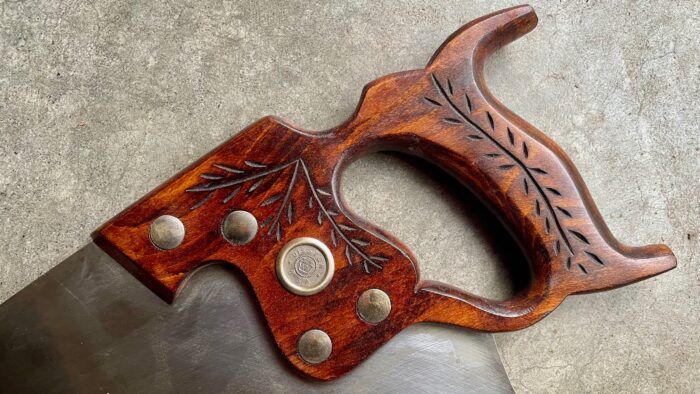
On this collection, I’ve been exploring the right way to make and modify handles for widespread hand instruments, with a deal with ergonomics. The motivation is private: I stay with continual hand ache from tendonitis and arthritis—problems of hemophilia and years of repetitive work—and small adjustments in software design make an enormous distinction. However whether or not you spend a number of hours every week within the store or construct full time, it’s price enthusiastic about how your instruments meet your fingers. Right this moment’s challenge: reshaping a blocky panel-saw deal with, including a contact of chip carving, and refinishing it for one more lifetime of use.
As soon as a month, my son and I wander by way of the Gorge ReBuild-It Middle looking for wooden, instruments, and different second-hand treasures. He is aware of to search for handsaws with one of the best handles, which often means the oldest saws—higher metal, higher craftsmanship. This time, although, I went in the wrong way. I discovered a Disston D-8 with a wonderful plate and a very terrible deal with. I’m no Disston historian, but it surely seemed mid-century: good metal, much less care put into the grip. For 5 {dollars}—my ordinary higher restrict for a challenge like this—we introduced it residence.

Getting the deal with off was straightforward sufficient; the nuts wanted a standard flathead as a substitute of a break up nut driver. The nickel-plated brass nuts steered it wasn’t as late because the ’70s or ’80s, when pot-metal {hardware} took over. To plan the reshaping, I studied a number of favourite saws, together with a Bishop rip noticed and a Disston crosscut with an additional thumbhole. I like the Disston’s smoothness, however the Bishop feels higher in my hand—bulkier, rounder, extra substantial. I made a decision to clean the D-8 deal with however maintain some mass as a compromise.

With the deal with clamped within the carving vise, I rasped down the sharp edges and used Japanese recordsdata to succeed in the tighter curves. Grain route on a form like that is difficult, so I labored fastidiously to keep away from tearout. A scraper took the end off the flat areas, and a razor blade dealt with the tight corners. The wooden seemed like a fine-grained fruitwood—apple or cherry, perhaps.

Subsequent got here sanding. For advanced curves, nothing beats chopping sanding belts into strips and “flossing” the deal with whereas it’s nonetheless within the vise. Each jiffy, I checked the slot in my hand, searching for excessive spots or cumbersome areas. That is the damaging a part of the job—the purpose the place you possibly can form away an excessive amount of. As a result of I’m a luthier, mixing flats and curves is acquainted work, however nonetheless arduous to explain. You need movement and smoothness with out shedding crisp sides. I’m after class, not a “Gumby” silhouette.

As soon as I’d sanded by way of 320-grit, I turned to ornament. Many elderly saws have wheat-pattern chip carvings, doubtless completed by machine within the manufacturing facility, although some look hand-cut. I’m no chip-carving knowledgeable, however I practiced on scraps throughout a current tenting journey. The chip-carving knife gave me the closest look to the previous manufacturing facility model, so I penciled within the sample from my Bishop noticed and dove in.

The secret is committing to scrub, single strokes. A number of little cuts make the design look fussy. I attempted carving within the vise however finally held the deal with in my lap for higher management. After carving, I sanded as much as 400-grit, cleaned up the wheat sample, and utilized alcohol-based stain, shellac, and wax. The end result appears to be like nice—and feels much better within the hand.
 |
 |
In fact, the blade wanted consideration too: rust removing, tooth setting, and submitting for rip. That was as a lot work because the deal with, and a narrative for one more time. This blade turned out to have a breasted toothline—a mild curve that’s supposed to assist with heavy rip cuts. It’s the one noticed I personal with this characteristic, so I’m excited to place it by way of its paces. At 5 tpi, it’s a rough, keen cutter on the noticed bench. When ripping cherry and poplar, I discovered the deal with snug in each one-handed and two-handed grips. Utilizing each fingers distributes the hassle, which helps with my hand ache.

A challenge like that is undeniably extra work than shopping for a ready-to-use noticed. However restoration teaches you in regards to the software—its lineage, its design, its quirks—and builds a way of possession that store-bought instruments hardly ever match. And there’s satisfaction in rescuing one thing discarded and giving it new life.

For those who’ve ever hesitated to refine a clunky noticed deal with, I hope this encourages you to offer it a attempt. There are many blocky handles on the market ready for a second probability.
Effective Woodworking Really helpful Merchandise

Bahco 6-Inch Card Scraper
The scale and thickness are what matter right here. A constant performer, this Bahco scraper is discovered in lots of outlets we go to.
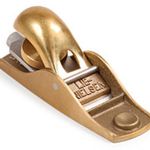
Lie-Nielsen No. 102 Low Angle Block Airplane
With clean, exact changes and great stability, this compact block aircraft is a pleasure to make use of. It doesn’t have any bells and whistles, however there’s not a greater block aircraft obtainable for the cash.
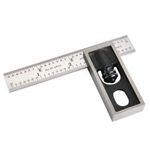
Starrett 4″ Double Sq.
Head is straightforward to take away, change, and lock down; narrowest blade, at 5⁄8 in., made it simpler to suit into tight locations; arduous to learn below shiny lights.
Join eletters right now and get the most recent strategies and how-to from Effective Woodworking, plus particular affords.