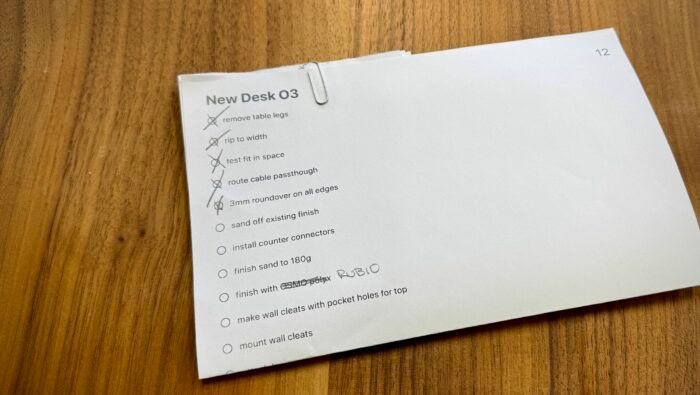
Each challenge in my store begins the identical means. Earlier than a software is plugged in or a aircraft is picked up, I make a listing.
I name it a triple-O—order of operations. It sounds formal, however it’s something however. It’s merely a method to assume by means of a challenge earlier than the wooden begins disappearing. Woodworking has a whole lot of shifting elements, and as soon as you narrow one thing, you don’t get it again. A guidelines slows you down simply sufficient to maintain you out of bother.
I do that for nearly every part, not simply woodworking. Any challenge with a number of steps will get written down. That behavior comes straight from my time within the army. Every little thing had a guidelines: gear upkeep, packing, prep work. If one thing mattered, it was written down within the order it wanted to occur—not as a result of we couldn’t bear in mind however as a result of reminiscence is unreliable when issues get busy.
The identical is true within the store.
Woodworking rewards doing issues in the appropriate order. Minimize your joinery earlier than you form the half. Drill holes earlier than you assemble. Flatten reference faces earlier than you begin worrying about thickness. Ignore that order, and you’ll ultimately end up making an attempt to clamp an oddly formed piece of wooden whereas asking why you probably did this to your self. Everybody has been there. A guidelines retains you from repeating the identical errors.
Proper now, I’m changing an previous eating desk I constructed years in the past into an L-shaped desk for my house workplace. It isn’t a sophisticated challenge, however it has sufficient steps that the order issues. Break down the highest. Add the brand new joinery. Take a look at match every part earlier than last meeting. Every step builds on the final. Miss one, or do it out of sequence, and the entire thing will get more durable than it must be.
I like utilizing a digital software to make my lists. Typically it’s a phrase processor like Pages. Typically it’s my Reminders app. (I’m a Mac man, however there are many equivalents for Home windows.) The large benefit is flexibility. I can transfer steps round simply. If I’m midway by means of typing and understand step 4 ought to actually occur earlier than step 3, I can reorder issues in seconds.
After I used to do that on paper, I left three clean traces between every step. That means, I may add issues I forgot or shuffle the order with out rewriting the entire listing. As soon as the listing feels proper, I print it and convey it into the store.
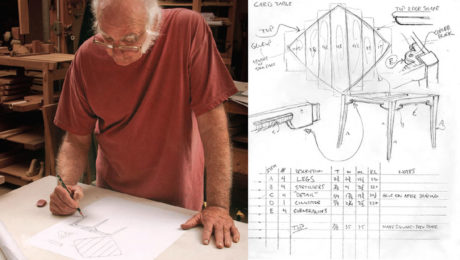
I additionally sketch small drawings of the vital data like dimensions or how joinery pertains to the assorted elements. These are small, tough drawings on quarter-sheets of paper—nothing fancy. These sketches get bundled with the guidelines in order that every part stays collectively in a single place: reduce lists, notes, dimensions.

The actual payoff is continuity. When life pulls me out of the store and into the workplace, I can come again later and know precisely the place I left off. There’s no guessing, no head scratching, no wasted time.
If you happen to work professionally, group saves cash. Time wasted is cash burned. If you’re a hobbyist, your store time is restricted. You may solely have an hour right here or there. Spending 20 minutes making an attempt to recollect what you had been doing is irritating and pointless.
Make a listing. Suppose it by means of. Then construct. Give it a shot.
Join eletters at the moment and get the most recent strategies and how-to from Effective Woodworking, plus particular affords.