I first discovered of those birch-bark containers by my Swedish buddy Jögge Sundqvist. They’re made in lots of elements of the world, significantly Scandinavia and Russia. I made one in a category with Jarrod Dahl, then later visited the person who taught him, Swedish craftsman Ramon Persson. A number of the Swedish examples I’ve seen exhibit a variety of joint configurations and intensive ornament, usually together with paint. The very best inspiration for these as we speak is the Russian maker Svetlana Koreneva (@koreneva_beresta).

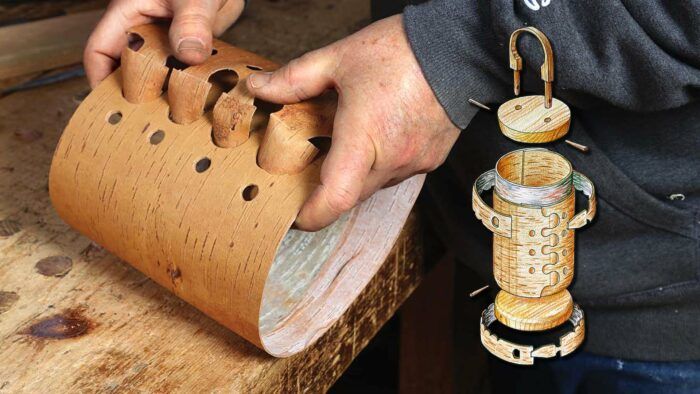
These containers have limitless makes use of, and their development is easy. The physique of the canister is 2 layers of bark, one inside the opposite. The skin layer has tabs and slots for joinery, whereas the within layer has no joinery. As soon as the underside and lid are in place, two narrower bands wrap across the prime and backside ends, including one other layer of ornament and enhancing the structural integrity.
Instruments and Supplies
There’s little strong wooden in these items, so the principle thrust of this undertaking is bark work. I get my bark in giant sheets from the Bark Canoe Retailer (barkcanoe.com), however you’ll find different on-line sources as nicely.
The dimensions of the bark you’re utilizing dictates the utmost measurement of your container. Aside from measuring the strip’s widths, there’s no math required. I eyeball as a lot as I can.
The present facet is the within of the bark, which ranges in coloration from yellow to orange. The white-and-black floor we use to determine birch doesn’t present within the completed work. Once you’re slicing out the strips, understand that the orientation of the bark within the completed piece is similar because it was within the tree, solely inside out. The horizontal lenticels—these darkish strains that wrap across the tree—wrap across the canister too.
The tooling used to make the canisters is minimal: a utility knife, sloyd knife, carving gouge, scissors, small handsaw, spokeshave, chisel, drill, and perhaps some punches for adorning.
Prepping the bark
I reduce the outer layer of bark with a utility knife and a straightedge. I study the bark to keep away from any giant flaws like cracks or splits. Pure bumps gained’t have an effect on how the bark works, however I attempt to place issues so these will not be on the joints.

On the strip’s outer floor I clear off all of the unfastened bark. A few of it may be peeled off; I abrade away any remaining unfastened bark with a convex rasp to cut back the thickness and take away any bumps and lumps that may maintain the 2 layers from mendacity tight to one another. I then skinny the bark in a swath about 1-1/2 in. to 2 in. broad at every finish of the outer layer to organize for slicing the joints.

Fingerish joints

With a uninteresting axe and a sq., I rating a line throughout the bark about 2 in. from one finish. It’s simply an impressed line I’m after, not a reduce.

To make the slots, I begin with a 3/4-in. chisel. I place it on the scored line and pierce the bark, pushing the chisel by it. The primary reduce is centered on the bark’s peak and is adopted by cuts proper on the prime and backside edges which might be solely half the chisel’s width. Additional cuts get spaced between these three.

To complete these openings, I change to a gouge. A deeply swept gouge is superb for this work; it varieties the complete half-circle in a single transfer. A less-curved gouge will work too; you simply must step over to complete the cuts.


Subsequent, I wrap the bark round itself to switch the positions of the openings to the opposite finish. After slicing these openings, I am going again to the primary set and reduce simply inside every opening to the tip, leaving an extended tab centered between the openings with a little bit of a shoulder on the finish. Some taper the width of these tabs to make them simpler to insert when connecting the canister’s outer layer. I exploit a slight taper simply on the finish due to the optionally available, ornamental gap I pierce within the outer layer. I would like the tabs to point out behind this gap.

Thinning these tabs makes them versatile for becoming the joints collectively. I exploit a convex rasp or coarse file on the white facet of the bark to abrade away a pair layers of the white bark relying on how thick the sheet of bark is. I typically fine-tune this thinning with a sloyd knife.

Peter Follansbee is an unplugged woodworker in Kingston, Mass.
To view your entire article, please click on the View PDF button under.
Join eletters as we speak and get the most recent strategies and how-to from Wonderful Woodworking, plus particular affords.
Obtain FREE PDF
once you enter your e mail handle under.