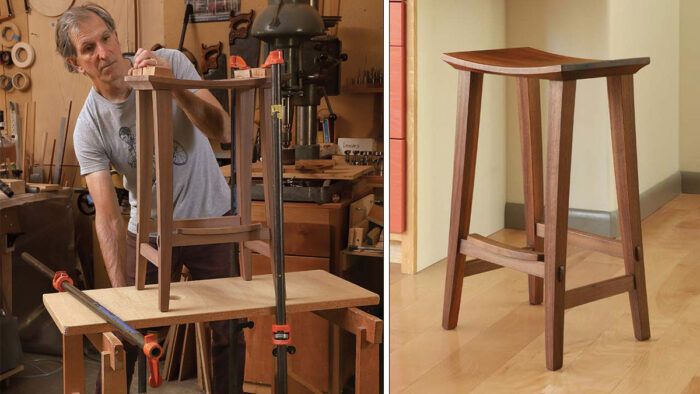
On this article, Tim Coleman describes the method he employed for crafting a set of counter stools. He mixed machine setups for joinery and preliminary shaping with hand instruments for element work. He shares the steps he took in creating the legs, stretchers, footrest, and seat, which required templates, exact angles, and cautious shaping. Coleman’s meeting course of highlights strategies for guaranteeing correct matches and accommodating wooden motion throughout ultimate development.
Magnificence in a mix of handwork and machine work
 I make loads of cupboards and tables, and often simply one after the other. However when a fee for seating furnishings comes my approach, it provides me an opportunity to suppose and work another way. Seating virtually all the time is available in multiples, and organising machines for producing stacks of equivalent components could be time-consuming, however I take pleasure in setup-focused work. There’s logic and certainty to it. But I additionally like the liberty and connection to the fabric that I really feel when I’m sculpting and carving.
Constructing a set of counter stools lately allowed me to work in each worlds, combining the effectivity of shared machine setups with shaping work that’s greatest achieved by hand. Machine setups produced the stools’ mortise-and-tenon joinery and the preliminary sizing of all of the components; after that, practically all the advanced shaping of the legs, stretchers, and seats was completed with freehand bandsawing and a spread of hand instruments.
| To view the complete article, please click on the View PDF button beneath. |  |

Join eletters right this moment and get the newest strategies and how-to from Wonderful Woodworking, plus particular presents.
Obtain FREE PDF
if you enter your e-mail tackle beneath.