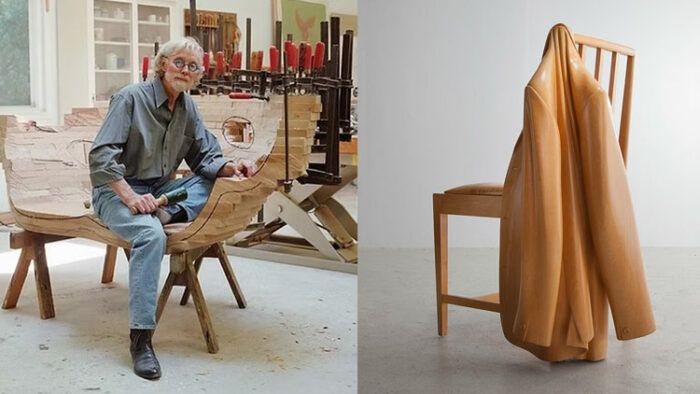
Wendell Fort was 43 and already broadly identified when Effective Woodworking launched in 1975. Having taught by way of the Nineteen Sixties within the College for American Craftsmen at Rochester Institute of Expertise, he had settled close by and constructed a fame with furnishings sculpted from stack-laminated strong wooden.
Fort had initially meant to change into an artist, however in 1958, whereas finding out sculpture on the College of Kansas, he paid a pivotal go to to Wharton Esherick in Paoli, Pa. It was not a heat encounter, however seeing the home and furnishings and art work that Esherick had made satisfied Fort it was doable to merge sculpture with furnishings. And it was this hybrid that fueled Fort’s lengthy, various, and terribly profitable profession.
Sculptors had been laminating blocks of wooden into carving blanks for hundreds of years, however Fort refined the approach by gluing up stacks of blocks so their general type approximated the form he meant to carve, drastically lowering the quantity of labor and waste concerned within the carving.
Carving furnishings out of blocks obviated the difficult means of conventional solid-wood furnishings making, in fact, and allowed him to shed the lengthy legacy of furnishings design.

Having achieved worldwide renown for his stacked work, Fort made a U-turn within the late Nineteen Seventies, when he started producing trompe l’oeil items like his chair with a carved coat draped from its crest rail. These items generated pleasure with their technical bravura and humorousness, however they stunned those that had learn Fort’s earlier work as a rejection of conventional furnishings.

From there, it was a brief step to a different controversial physique of labor, his Effective Furnishings line: hyper-traditional, high-style items aimed toward a rich clientele. It drew consideration for the issue and prime quality of its development; its price, which was deliberately precedent-setting; and its dizzying stylistic departure from his stack-laminated work.
Subsequent got here a collection of clocks, a few of which might stand with the strongest items of his profession. His stellar Ghost Clock, depicting a conventional interval tall clock obscured however nonetheless recognizable beneath a carved white sheet, may very well be seen as a self-portrait of the person and the strain in his work between furnishings and sculpture, custom and innovation.
Wooden itself was by no means a specific draw for Fort. In a area that worships its chosen materials, he was a heretic. He held the opinion that wooden was merely one other helpful substance and must be labored like a lot stone or clay or plastic. He wished the main focus to be on the form of a chunk slightly than on its supplies or construction. All through his profession, and particularly in his late work, he embraced an array of supplies from gel-coated fiberglass to forged resin and concrete. 
Join eletters at present and get the newest methods and how-to from Effective Woodworking, plus particular affords.