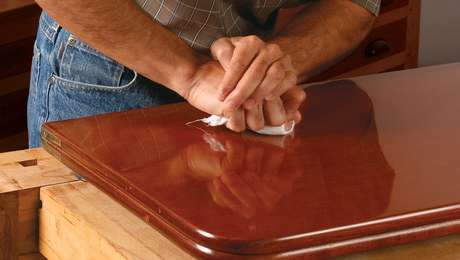
What does it imply to fill the grain, and why would you do it? Filling the grain is filling the pores of wooden, earlier than making use of a end, so the ultimate completed floor is completely clean. Assume piano end—not opaque on this case however with the identical unbroken polish. There are various merchandise and approaches for filling grain, however the closing look is comparable.
With woods like maple or cherry, which have tiny pores that might be stuffed by a film-forming end like shellac or polyurethane, grain-filling isn’t obligatory. However with larger-pored woods like mahogany, you’ll have to fill the grain to provide the flawless floor and deep sheen of a high-style look.
One of these end is hottest on interval reproductions, however it is going to make any mission look extra formal and provides small items like bins and bowls a jewel-like gleam. I additionally use grain filler to fill small defects in burl wooden.

Crammed grain isn’t acceptable for every type and kinds of woodworking tasks. Pores are one of many issues that make wooden appear like wooden, and you’ll beautify your materials and add a deep sheen with out filling the grain. In actual fact, many woodworkers choose to see and really feel some grain texture on their work. Additionally, any film-forming end will fill the pores at the very least partially, refining the look of the end with out subtracting any of its handmade really feel. Crammed grain can even conflict with the country enchantment of large-pored woods, like ash and oak.
But when a stuffed end appears proper in your mission, you’ll be blissful to listen to it’s simpler than ever, because of a brand new class of merchandise. Earlier than I get to them, let’s speak first concerning the conventional approaches.

The standard strategies
One of many oldest strategies for filling grain is French sharpening, a end made by mixing pumice into shellac. A correct French polish is a fantastic end, however making use of it entails a reasonably steep studying course of.
Oil-based grain fillers have additionally been round for a very long time. These are thick pastes which might be rubbed into the grain. They require a number of coats, and every coat has to dry in a single day earlier than the following is utilized. Additionally, the filler is opaque, which is nice if you wish to give the pores a contrasting coloration, however not so nice in the event you don’t.
You may also fill pores with the end itself. This requires fairly a couple of coats, although, and a good quantity of sanding to stage the floor. If the end is oil-based, every coat might want to dry in a single day.
A variation of filling with end is sanding the still-wet floor to create a slurry of sawdust and end. This fills the grain quicker than the end alone, nevertheless it requires much more sanding.
Waterborne fillers are a well-liked fashionable strategy. These dry clear, however they are often tinted with dyes or pigments to create pores with a contrasting coloration. Whereas they dry pretty shortly, they have an inclination to shrink as they do. So that they require additional coats, and they are often tough to sand.
My favourite filler

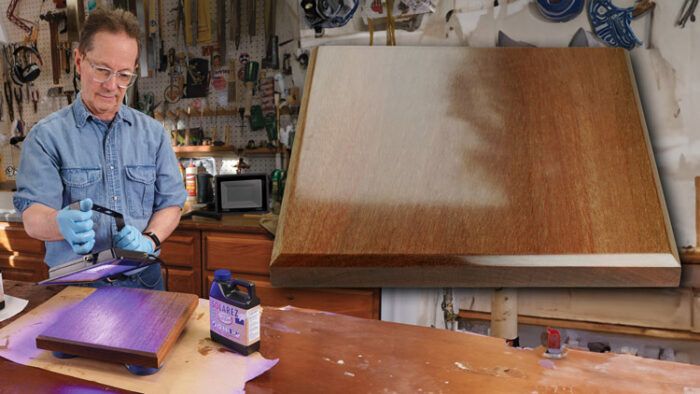
I’ve tried nearly each methodology, outdated and new, for filling pores, and my favourite by far is a brand new number of grain filler that cures quickly when uncovered to UV (ultraviolet) gentle. The product I take advantage of, which is made by Solarez, has a goofy identify—I Can’t Consider It’s Not Lacquer Grain Sealer. It’s cheap and easy to use. It cures in minutes in daylight, even on an overcast day, and it sands superbly. As a result of it has little or no shrinkage, it solely requires a couple of fast coats, and it may be adopted by any topcoat I do know of, oil-based or water-based. In brief, you may fully fill the grain within the morning and start making use of your favourite topcoat that very same afternoon. You may also use a synthetic supply of UV gentle to remedy the grain filler.
The way it works—In distinction to the sluggish oxidation different finishes depend on, UV-cured grain filler dries and cures shortly in UV gentle. If it isn’t uncovered to UV gentle, a UV-cured grain filler will stay moist for days. This implies you could have limitless time to use it and alter the quantity left within the pores. Store lights don’t emit sufficient UV gentle to remedy the filler, so that you simply need to be careful for direct sunbeams coming by means of the home windows.
I Can’t Consider It’s Not Lacquer Grain Sealer is 100% resin (in accordance with the producer) and doesn’t comprise solvents, so it doesn’t shrink a lot in any respect. That’s why it solely takes two or three fast coats to fully fill the grain, and likewise why a bottle of the product will go so much farther than an equal quantity of solvent-based filler.
Use it with film-forming finishes—As a result of grain-filling begins to construct a movie on the floor and inhibits oil finishes from penetrating into the wooden, I’d solely use grain fillers with a film-forming end, equivalent to lacquer, shellac, or polyurethane.
Methods to apply the grain filler

Earlier than filling the grain, I sand the floor as much as 180 or 220 grit. Then the filler goes on. You’ll be able to apply it with absolutely anything. To unfold it thinly and evenly and decrease sanding, I apply it with a squeegee once I can, just like the 7-in.- or 8-in.-wide sort offered for showers. For vertical surfaces and edges, I take advantage of a cheap nylon paintbrush.
 |
 |
I Can’t Consider It’s Not Lacquer Grain Sealer is a bit thicker than oil-based topcoats like polyurethane, and a bit of bit goes a great distance. On horizontal surfaces, I pour a small quantity instantly from the bottle and unfold it round with the squeegee. I generally use an outdated bank card on small tasks. You’ll be able to’t pour the filler onto vertical surfaces, so I take advantage of a nylon brush to work it into these.

I take advantage of the squeegee to take away no matter extra is there, and a brush or rag the place the squeegee received’t work. This may scale back the quantity of sanding required. If you’re after a completely stuffed floor, the aim is to take away the surplus on the floor with out pulling filler out of the pores.

Shield the mission from direct daylight till you might be prepared for it to remedy.
Resin cures in pure or synthetic gentle
To remedy the grain filler, I nearly at all times take the piece exterior and expose it to the solar. Full solar will remedy the surfaces in simply two or three minutes. On an overcast day, it would take 5 or 6. You received’t have to maneuver the mission round a lot, as a result of ambient daylight will remedy all uncovered surfaces. The solar’s rays aren’t as robust within the winter, however they may nonetheless remedy the filler, and chilly temps aren’t an issue.

Synthetic UV lights—You may also use a cheap UV lamp to remedy these merchandise. For infrequent use, I like to recommend the LED blacklights offered on Amazon that emit the fitting wavelength of UV gentle and do a tremendous job curing the resin. At below $30 every, they’re so cheap that you could possibly purchase two of them to hurry issues up.

I Can’t Consider It’s Not Lacquer Grain Sealer requires UV gentle with a 385nm wavelength, so test the specs on a light-weight before you purchase. To make the method go shortly, make sure the lamp is rated for at the very least 150 to 200 watts.
One or two extra fast coats
 |
 |
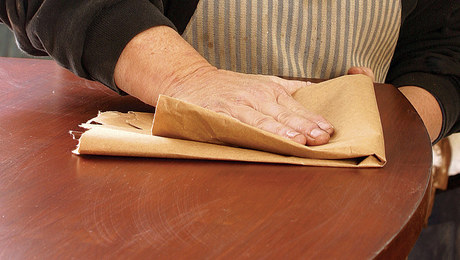
As soon as the primary coat is cured, frivolously sand off the surplus on the floor. Don’t over-sand, or you’ll sand previous the skinny layer of filler within the pores and want to start out once more. Apply further coats in the identical means till the pores are fully stuffed and the floor has no texture. Sand after the final coat with 180- to 220-grit paper to prep the floor for a topcoat.
Partially stuffed grain is a pretty choice

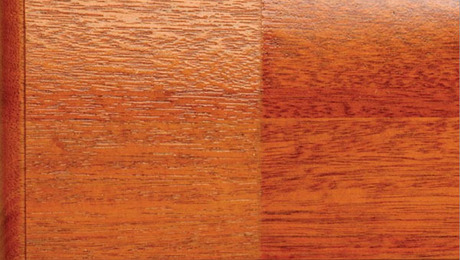
I Can’t Consider It’s Not Lacquer Grain Sealer will also be used to fill pores partially, giving open-pored woods a barely extra formal and refined look with out detracting from a chunk’s handmade look. That’s what I did on the mahogany nightstand pictured beneath.
Partially stuffed grain appears to be like nice on larger-pored woods just like the mahoganies, sapele, and padauk. It doesn’t make as a lot sense on woods with medium-size pores, equivalent to walnut, as a result of a movie end will fill these pores partially by itself.
As earlier than, prep the wooden floor as much as 180 or 220 grit, and apply the filler nevertheless you need. The principle distinction right here is the way you take away the surplus. Use a rag this time, which is able to allow you to pull among the filler out of the pores. Shifting the rag within the path of the grain will pull out extra filler; transferring it throughout the grain will pull out much less.
After the filler is cured and sanded, take a detailed look and resolve whether or not the pores are stuffed sufficient for the look that you really want. It’s simple to use one other skinny coat or two if wanted.
Charlie Kocourek lives in Minneapolis and teaches ending at a number of woodworking faculties.
Wonderful Woodworking Really helpful Merchandise
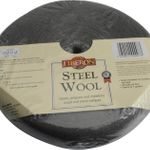
Liberon Metal Wool
Good for rubbing out a end for a low-luster sheen.

Bahco 6-Inch Card Scraper
The scale and thickness are what matter right here. A constant performer, this Bahco scraper is discovered in lots of retailers we go to.

Festool Rotex FEQ-Plus Random Orbital Sander
The Festool Rotex is a top-of-the-line selection. On its coarse setting, it eliminated inventory practically twice as shortly because the second-fastest mannequin. However that velocity doesn’t imply you’ll need to wrestle with it. It’s no enormous process to manage it with two fingers, and its lengthy physique provides you loads of room to discover a candy spot whereas holding it.
Join eletters right now and get the most recent strategies and how-to from Wonderful Woodworking, plus particular provides.
Obtain FREE PDF
if you enter your electronic mail deal with beneath.